Cyber insurance in India is no longer optional it’s a financial safety net for data breaches, ransomware, regulatory fines and business interruption. This guide explains what cyber insurance is, how policies work in India (including DPDP & CERT-In requirements), typical coverages and exclusions, how pricing and underwriting work, and practical next steps for buyers from SMEs to MNCs.
What is Cyber Insurance?
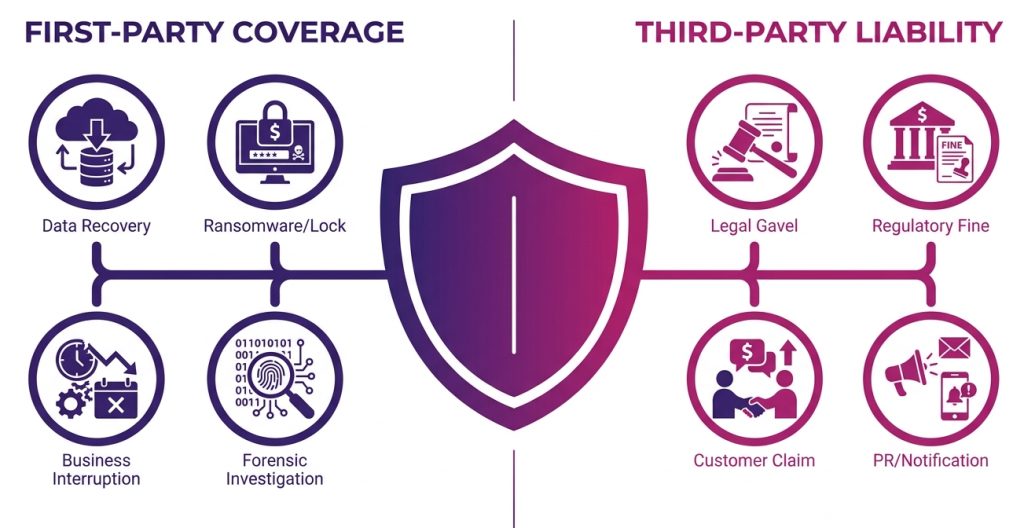
Cyber insurance, also known as cyber liability insurance or cyber risk insurance, is a type of insurance that helps businesses recover from financial losses caused by cyber incidents.
In simple terms, it protects your business when something goes wrong digitally such as a data breach, ransomware attack, system hack, payment fraud, business email compromise, or customer data leak.
Cyber incidents can quickly become expensive. A business may need to pay for forensic investigation, data recovery, legal support, customer notification, crisis communication, regulatory response, and even business interruption losses. Cyber insurance helps cover these costs so the business is not left handling the full financial damage alone.
Cyber insurance usually covers two major areas:
1. First-Party Cyber Coverage
First-party coverage protects your own business from direct losses caused by a cyber event. This may include:
- Data Recovery Costs: Helps cover restoring systems, recovering files, and rebuilding lost data if business data is deleted, corrupted, encrypted, or stolen.
- Ransomware and Cyber Extortion: May cover ransom negotiation support, specialist response teams, and related recovery expenses if hackers lock systems or demand payment.
- Business Interruption Losses: May cover lost income when a cyberattack stops operations, websites, payment systems, or internal tools.
- Forensic Investigation: Helps cover expert investigation costs to identify what happened, how attackers entered, and what data was affected.
- Customer Notification and PR Costs: May cover customer notification, support, public communication, and reputation management costs after a data exposure.
2. Third-Party Cyber Liability Coverage
Third-party liability coverage protects your business when other people or organisations make claims against you because of a cyber incident.This may include:
- Legal Defence Costs: May cover legal fees and defence costs if customers, vendors, partners, or other affected parties take legal action after a data breach or cyber incident.
- Regulatory Fines and Penalties: May cover certain fines, penalties, and investigation-related costs if regulators investigate the business after a cyber incident, where legally insurable.
- Settlements and Compensation: May cover settlements or compensation payments if the business is found responsible for exposing sensitive data or failing to protect systems properly.
- Claims from Customers or Partners: Helps manage liability risks if customers, suppliers, or business partners claim financial loss due to a cyber incident.
Types of Cyber Insurance Policies in India
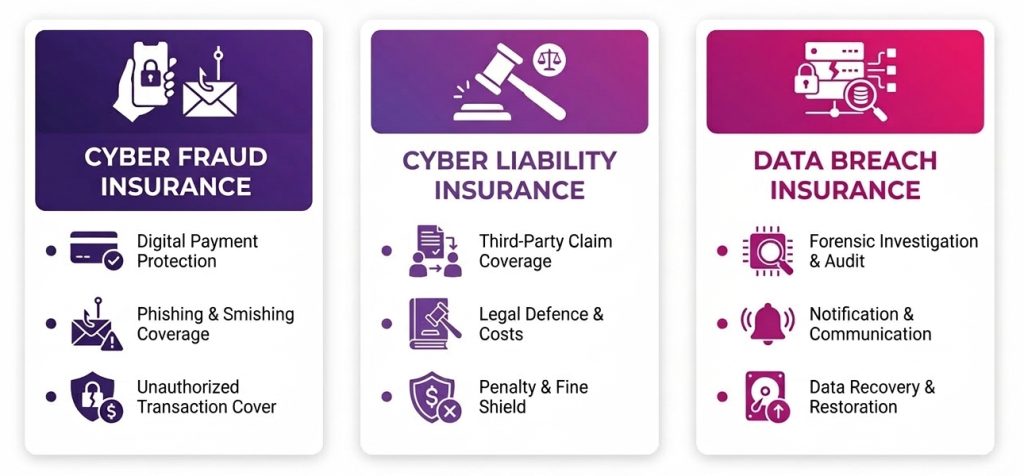
Cyber insurance policies in India are designed to cover different types of digital risks businesses face. The three primary types include cyber fraud insurance, cyber liability insurance, and data breach insurance.
1. Cyber fraud insurance
Protects against financial losses caused by online fraud, phishing attacks, and unauthorised transactions. It is essential for businesses handling digital payments or banking systems.
2. Cyber liability insurance
Covers legal and regulatory costs arising from data breaches or cyber incidents. This includes third-party claims, legal defence, and penalties if customer or partner data is compromised.
3. Data breach insurance
Focuses on the costs associated with responding to a breach. It includes expenses for forensic investigations, customer notifications, data recovery, and reputation management.
Most businesses opt for a comprehensive policy that combines these coverages to ensure complete protection against financial, legal, and operational cyber risks.
The CyberThreat Landscape in India
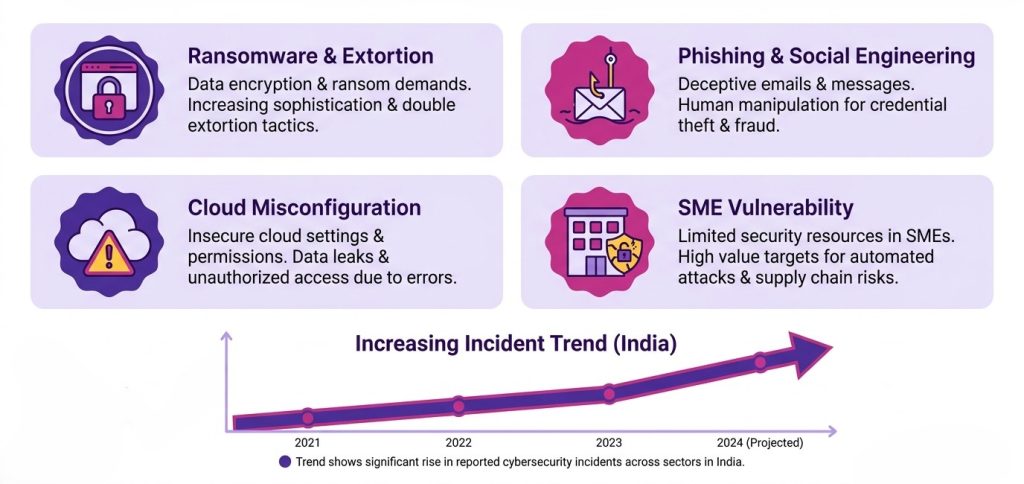
1. Ransomware and Extortion
Ransomware continues to be one of the biggest cyber insurance claim drivers globally and in India.In a ransomware attack, hackers may lock business systems, encrypt data, or threaten to leak sensitive information unless a payment is made. The financial impact can be serious because businesses may face ransom demands, downtime, forensic investigation costs, legal expenses, and system recovery costs.
2. Phishing and Social Engineering
Phishing and social engineering remain among the most common ways attackers gain access to business systems.Employees may receive fake emails, messages, payment requests, or login pages designed to steal passwords or trick them into transferring money. Even businesses with good security tools can be exposed if employees are not trained to identify these attacks.
3. Cloud Misconfiguration Risk
As more businesses move to cloud platforms, cloud security has become a major risk area.Misconfigured cloud storage, weak permissions, exposed databases, and poor access controls can lead to large-scale data exposure. In many cases, the issue is not a sophisticated hack but a simple configuration mistake that leaves sensitive data accessible.
4. Supply-Chain Attacks
Businesses increasingly depend on vendors, software tools, SaaS platforms, payment systems, and third-party integrations.A supply-chain attack happens when attackers compromise a vendor or technology partner and use that access to affect other connected businesses. This risk is growing because even a company with strong internal security may still be exposed through weaker external partners.
5. SME Vulnerability
Small and mid-sized businesses are especially vulnerable to cyber incidents.Many SMEs do not have mature cybersecurity controls, tested backups, incident response plans, dedicated security teams, or cyber insurance. While industry reports show that companies are increasing their spend on proactive cybersecurity, major gaps still remain.
For SMEs, one cyber incident can create a serious financial and operational shock.
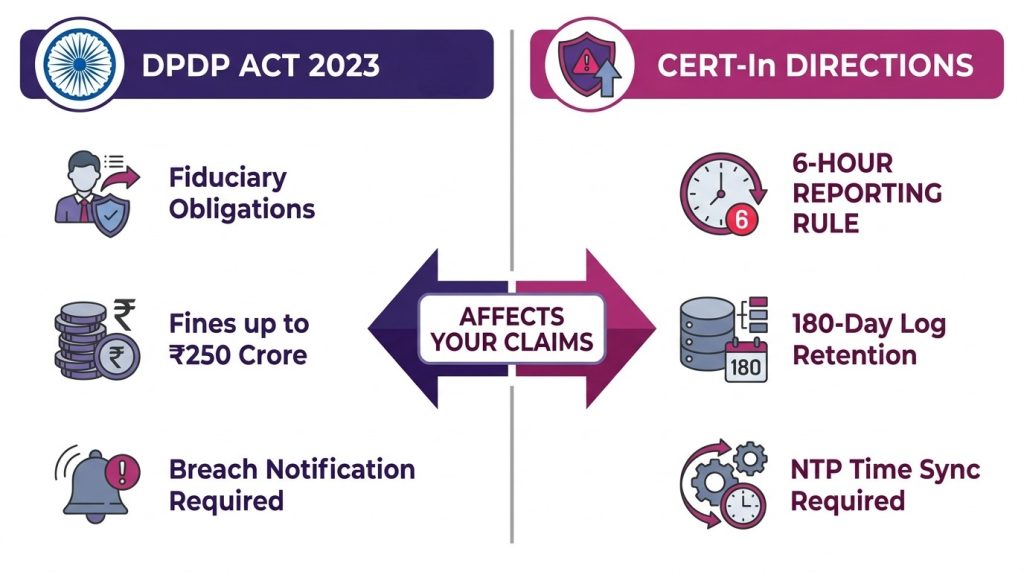
Two regulatory items particularly affect cyber insurance in India: the Digital Personal Data Protection (DPDP) Act and CERT‑In directions.
1. DPDP Act, 2023
The DPDP Act creates obligations for organisations that collect, process, or store personal data. It gives rights to individuals and places duties on businesses to protect personal data properly.
Non-compliance can lead to significant penalties, with public references citing fines of up to around ₹250 crore for serious violations. The Act also increases exposure around data breach notification, legal defence, representation costs, and regulatory response.
2. CERT-In Directions
CERT-In requires certain cyber incidents to be reported within 6 hours of detection. This makes fast incident identification, escalation, forensic readiness, and insurer notification extremely important.
CERT-In directions may also require ICT system logs, including cloud logs, to be retained in India for up to 180 days, with proper time synchronisation for accurate timestamps.
Impact on Cyber Insurance
Cyber insurers will expect businesses to comply with DPDP and CERT-In requirements. Failure to meet reporting, log retention, or data protection obligations can complicate claims, trigger exclusions, or reduce claim recovery.
Businesses should align their compliance, cybersecurity, legal, and insurance teams before an incident happens not after.
Why Businesses in India Need Cyber Insurance
- Financial protection: Helps cover data breach costs, recovery expenses, and business interruption losses.
- Regulatory defence support: Can cover legal representation, defence expenses, and regulatory response costs related to DPDP or other compliance matters.
- Access to incident response experts: Many insurers provide 24/7 access to forensic, legal, breach response, and crisis management panels.
- Faster recovery: Expert support can reduce downtime, improve response quality, and control recovery costs.
- Supply-chain requirements: Larger customers, enterprise clients, and partners may require vendors or suppliers to carry cyber insurance.
- Protection against ransomware exposure: Policies may cover extortion response, negotiation, recovery support, and related costs, depending on wording.
What Does Cyber Insurance Cover? and What is NOT Covered in Cyber Insurance?
| Covered (commonly) | Typical exclusions/limits |
|
|
Industry‑Specific Cyber Insurance Use Cases

Cyber risk looks different by industry. Insurers offer tailored wordings and endorsements to address these differences.
- Healthcare: Patient data breaches, ransomware on clinical systems, EHR recovery.
Coverage highlights: medical device support, patient notification, regulatory defence. - BFSI: Payment fraud, core banking outages and regulatory scrutiny.
Coverage highlights: transaction fraud, wire transfer losses, and regulatory defence. - Retail & E‑commerce: PCI/DSS issues, cardholder data exposure, DDoS.
Coverage highlights: card breach response, customer remediation. - SaaS & Tech: Cloud misconfigurations, API exposures, and E&O claims from clients.
Coverage highlights: Tech E&O, client indemnity, service interruption. - Manufacturing & OT: OT/ICS/SCADA ransomware and supply chain interruption.
Coverage highlights: production downtime, IP theft response.
Cyber Insurance for MNCs & Large Enterprises in India
MNCs face complex exposures: cross‑border data flows, multi‑jurisdictional regulations (GDPR, DPDP), global vendors and potential nation‑state threats. Placement often requires bespoke wordings and layered programs combining domestic and international markets.
Key considerations when buying as a large enterprise:
- Broker expertise: A broker experienced in cyber placements and global markets is essential; they negotiate terms, coordinate excess layers and align policy wordings across jurisdictions.
- Multi‑jurisdiction coverage: Ensure DPDP and GDPR exposure is covered, and clarify whether fines and regulatory defence are insured in relevant jurisdictions.
- Contingent business interruption: Include coverage for vendor outages and supply‑chain failure where revenue depends on third parties.
- State‑sponsored exclusions: Understand how the policy treats nation‑state attacks; many carriers narrow or price this exposure separately.
- Do I need a broker? For complex or high‑capacity placements, a broker is highly recommended, as they add market access, wording expertise and claims advocacy during incidents.
Practical next steps for buyers (SMEs to MNCs)
- Run a rapid cyber risk assessment (identify crown jewels, revenue‑critical systems and vendor exposures).
- Document your incident response plan and ensure backups, MFA and endpoint detection are in place.
- Talk to a cyber broker or insurer early — get a pre‑bind security assessment to identify gaps that will raise premiums or cause exclusions.
- Clarify policy details: retroactive date, sublimits (ransom, regulatory fines), waiting periods and the insurer’s stance on nation‑state exclusions.
- Test claims readiness: perform tabletop exercises with your insurer/broker and ensure CERT‑In reporting and log retention practices are operational.
- Internal resources: see our suggested internal links for policy types, incident‑response checklist and underwriting tips to refine your buying strategy.
Cost comparison: Breach losses versus insurance

| Item | Typical breach cost (illustrative) |
|---|---|
| Forensics & investigation | INR5–20 Lakh |
| Business interruption (lost revenue) | INR10–100 Lakh+ |
| Regulatory fines / defence | INR10 Lakh – Crores (depending on DPDP) |
| Ransom/extortion | Varies widely |
Why Work with a Cyber Insurance Broker?
- Better policy customisation: Brokers assess your business model, data exposure, and industry risks to recommend tailored coverage instead of generic policies.
- Access to multiple insurers: They help you compare plans across different insurers, ensuring better coverage options, competitive pricing, and informed decision-making.
- Claims support: In case of a cyber incident, brokers guide you through the claims process, from documentation to settlement, reducing delays and confusion.
- Risk advisory: Brokers identify potential vulnerabilities in your systems and suggest improvements, helping you strengthen cybersecurity and potentially lower premiums.
Conclusion
Cyber insurance in India in 2026 is an essential part of a layered cyber risk strategy. It complements technical controls and helps manage financial, regulatory and reputational fallout from incidents. Start by conducting a focused risk assessment, document your BI exposure and vendor map, confirm DPDP and CERT-In obligations, and then seek quotes while comparing wordings not just price.
FAQs
1. Does cyber insurance cover ransomware payments in India?
Often yes many policies include ransomware/extortion cover for payments, negotiation and decryption support, but this depends on policy wording and local law. Some insurers restrict payments for state‑sponsored or sanctioned actors; confirm sublimits and requirements (e.g., use of insurer‑approved negotiators).
2. How does the CERT‑In 6‑hour reporting rule affect claims?
CERT-In’s 6-hour reporting creates strict timelines for detection and notification. Non‑compliance can complicate claims, so insurers expect evidence of rapid detection, preserved logs and documented incident triage. Maintain synchronised time stamps and 180‑day log retention to support investigations.
3. How much does cyber insurance cost for an SME in India?
Premiums vary by industry, revenue, security posture and claims history. Small SMB policies with modest limits can be affordable; underwriting discounts are available for strong controls (MFA, backups, endpoint protection). Obtain quotes from multiple carriers or a broker for specific pricing.
4. What are the most common exclusions in cyber insurance policies?
Common exclusions include war/nation‑state attacks, intentional criminal acts by employees, known/circumstantial acts before the retroactive date, and some types of contractual liability. Always read exclusions and request endorsement language if needed.
5. Can cyber insurance cover fines or penalties under the DPDP Act?
Some policies provide cover for regulatory defence and fines under DPDP, but coverage depends on the policy wording and local law. Insurers may cover defence costs and representation; coverage for statutory fines varies—confirm limits and any proscriptions in the policy.